
Microsoft Reading Coach
How This Free AI Tool Improves Kids’ Pronunciation & Fluency
Redefining the New Paradigm of Office Collaboration: A Team-Collaboration AI Agent Tailored for the Southeast Asian Market
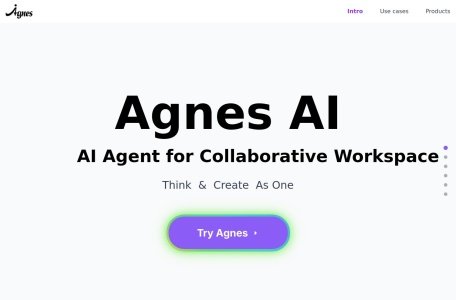
 Agnes AI
Under the trend of globalized office, cross-regional teams often face the triple dilemma of “collaboration disconnection, efficiency loss, and cultural adaptation” – when a Singapore enterprise synchronizes its project with its Vietnam branch, the language difference leads to document comprehension bias; remote teams need to repeatedly transmit documents for editing presentations, and there are frequent problems of version confusion; in cross-border projects, it is difficult to synchronize members’ historical operation records with the task status. When synchronizing projects between the Singapore enterprise and its Vietnam branch, language differences lead to deviations in document understanding; remote teams need to repeatedly transfer documents to edit presentations, which leads to frequent problems of version confusion; in multinational projects, it is difficult to synchronize members’ historical operation records with the task status, and newcomers need to spend a lot of time sorting out context. Agnes AI, launched by Singapore’s Sapiens AI team, takes “Team Collaboration AI Agent” as its core positioning, and becomes the “Collaboration Adhesive” in Southeast Asia’s office scenarios by virtue of its features such as shared memories, real-time collaboration, and multi-language adaptation. “Agnes AI completely breaks the limitations of traditional office tools and realizes a qualitative leap in the collaboration efficiency of cross-region and multi-language teams.
The most disruptive value of Agnes AI is that it jumps out of the traditional office software “single function, fragmented collaboration” limitations, around the office needs of the Southeast Asian market, to build an integrated “content generation – real-time collaboration – memory sharing – cross-end adaptation” collaboration system, which accurately solves the three core pain points. The value is that it goes beyond the limitations of traditional office software “single function, fragmented collaboration”, and builds an integrated system of “content generation – real-time collaboration – memory sharing – cross-end adaptation” around the needs of the Southeast Asian market.
In traditional office collaboration, the “information gap” is the biggest efficiency killer – new members joining a project need to comb through chats and file versions from scratch, and historical task status is lost due to member departure or device change. Agnes AI’s Shared Memory feature revolutionizes this: it permanently preserves users’ historical preferences (e.g., common document formats, editing styles), task statuses (e.g., unfinished report sections, PPT revisions awaiting feedback), and team collaboration history (e.g., who changed what and when, and annotated what for feedback) across documents, conversations, and projects. For example, a multinational marketing team promotes the “Southeast Asia New Product Promotion Project” in Agnes AI. Even if a Vietnamese member leaves the company or a Singaporean member changes computers, the new receiver can still view the complete project evolution through Shared Memory after logging in: from the initial draft of the program, the modification traces of each member, to the adjustments made by the client’s feedback. From the initial draft of the project, to the revision traces of each member, to the adjustments of the client’s feedback, all the contexts can be seen at a glance, so that they can quickly take over the work without any additional communication. This “uninterrupted memory” feature ensures the continuity of teamwork.
The “asynchronous collaboration” model of traditional office tools puts cross-location teams in an inefficient cycle of “pass file – wait for feedback – change version”. agnes AI supports real-time online editing of documents and slides by multiple people, with all changes synchronized in real time, and traces of members’ actions clearly visible – when a Singaporean member adds a “product price list” to a presentation, the Vietnamese member can see the update instantly and directly see it. All changes are synchronized in real time, and traces of members’ actions are clearly visible – when a member from Singapore adds a “product price list” to a presentation, a member from Vietnam can instantly see the update and add a “local market promotional strategy” on the same page; if there is any dispute about the content, the member from Vietnam can see the update. “If there is any disagreement on the content, you can mark your comments (e.g. “This price should be adjusted with local tax” in Vietnamese) through the real-time annotation function, and the AI will automatically keep a record of the annotations and associate them to the corresponding content paragraphs, avoiding disputes at a later stage. What’s more, the system supports “version tracking”, so if you delete key content by mistake, you can restore it to any historical version with a single click, completely solving the difficult problem of “version confusion”. After a Southeast Asian e-commerce company used Agnes AI, the presentation production time of a multinational sub-team was shortened from 3 days to 8 hours, and communication costs were reduced by 60%.
The Southeast Asian market, due to the diversity of languages (English, Vietnamese, Malay, Thai, etc.), often has the collaboration barrier of “document translation deviation, instruction understanding error”.Agnes AI optimizes the multi-language function in a targeted way, which not only supports multi-language input and output, but also accurately comprehends the office terminology and cultural context of different languages. For example, if a member from Malaysia inputs “Generate a market research report on durian products, including consumer preference and analysis of competing products” in Malay, Agnes AI can accurately recognize the regional characteristics of “durian products” and generate a structured report that meets the needs of the Southeast Asian market; in Singapore, Agnes AI can generate a structured report that meets the needs of the Southeast Asian market. The Agnes AI can accurately recognize the geographical attributes of the durian product and generate a structured report that meets the needs of the Southeast Asian market; the Singaporean member annotates “need to add Indonesian market data” in English, and when the Vietnamese member views it, the system automatically translates the annotation into Vietnamese and retains the accuracy of the terminology (e.g., “market penetration” is not ambiguous due to the translation). (e.g. “market penetration” will not be ambiguous due to translation). This “seamless language switching” capability allows Southeast Asian multilingual teams to collaborate and communicate more smoothly without relying on third-party translation tools.
Agnes AI designs functions around the “team office cycle”, deeply integrating AI content generation and team collaboration to form a closed loop of “demand input – content generation – real-time collaboration – feedback and optimization – cross-end synchronization”, maximizing office efficiency.
As a collaborative AI Agent, Agnes AI is equipped with powerful content generation capabilities, which can quickly output office documents that meet professional standards, eliminating the need for members to manually create from scratch:
In response to the trend of telecommuting and flexible working in Southeast Asia, Agnes AI realizes “seamless cross-device switching” and “asynchronous collaboration”:
Agnes AI does not force teams to change their existing work habits, but integrates easily into existing processes by seamlessly interfacing with Slack, Teams, and other commonly used office software. For example, in Slack, a team can directly send the command “Let Agnes AI generate this week’s project progress report”, and the system will automatically generate the report and return it to the Slack chat window; in Teams meetings, members can call Agnes AI to record the meeting points in real time, generate structured minutes and synchronize them to the project workspace, eliminating the need to switch between multiple tools. In Teams meetings, members can call Agnes AI to record meeting points in real time, generate structured minutes, and synchronize them to the project workspace without switching between multiple tools. This “zero-learning-cost” integration eliminates the need for teams to spend time adapting to new tools and enables efficient collaboration.
The smooth collaboration experience of Agnes AI comes from two core technical supports — Agnes-R1, a self-developed 7B parameter inference model, and CodeAgents multi-intelligent body inference framework, which provide a solid foundation for the function to be realized.
Traditional small-parameter models often suffer from “comprehension bias and logical breaks” when dealing with long documents and multiple rounds of reasoning.Agnes-R1, a 7B parametric reasoning model developed by Agnes AI, has been optimized for office scenarios:
Agnes AI is not a single intelligence, but a multi-intelligence system based on the CodeAgents framework: when the team initiates a collaborative task, the system will automatically dispatch multiple specialized intelligences, such as “Content Generation Intelligence”, “Collaborative Editing Intelligence”, “Memory Storage Intelligence”, “Language Translation Intelligence”, etc., to work together. When the team initiates a collaborative task, the system will automatically dispatch multiple specialized intelligences such as “content generation intelligence”, “co-editing intelligence”, “memory storage intelligence” and “language translation intelligence” to work together. For example, when generating the “Southeast Asia Multilingual Market Report”, the “Data Collection Intelligence” is responsible for capturing market data from various countries, the “Content Generation Intelligence” writes the body of the report, and the “Language Translation Intelligence” writes the body of the report. The “Language Translation Intelligence” translates key parts into Vietnamese and Malay, and the “Formatting Intelligence” unifies the document style. All the intelligences work in synchronization to ensure fast and high-quality output of the report. This multi-intelligence collaboration model not only improves the efficiency of task processing, but also reduces the risk of single-intelligence failure.
With multi-language adaptation and localization optimization, Agnes AI is widely used in Southeast Asian office scenarios, from enterprise management to academic research, from marketing to product design, all of which can provide accurate collaboration solutions.
Southeast Asian multinationals have dramatically improved their project management efficiency after using Agnes AI. For example, when synchronizing the “factory expansion project” between the Singapore headquarters and the Vietnam branch, members from both sides edited the project plan in Agnes AI in real time: the Singapore team marked “budget allocation plan” in English, and the Vietnam team added “local building materials procurement channels” in Vietnamese. The Singapore team marked “budget allocation plan” in English, and the Vietnamese team added “local building materials sourcing channels” in Vietnamese. Changes were synchronized in real time, and Shared Memory recorded all the traces of adjustments; the AI also automatically generated project schedules with “approval nodes to be confirmed” and “local policy documents to be supplemented”, and automatically generated the project schedule. AI also automatically generates project schedules, labeled with “approval nodes to be confirmed” and “local policy documents to be supplemented”, and pushes reminders to the corresponding person in charge via Slack. This collaboration model reduces project communication time by 50% and improves decision-making efficiency by 40%.
With Agnes AI, market research teams can efficiently complete cross-country and multi-language report generation. A Singaporean consulting company analyzed “Southeast Asia Beauty Market Trends” for a client. After inputting the requirements in Agnes AI, the system automatically generated a report framework containing a structured outline, and the team members divided the work among themselves: the Malaysian members added “Kuala Lumpur consumer preference data”, the Thai members added “Bangkok offline channel analysis”, and the Thai members added “Bangkok offline channel analysis”. Team members divide the work: Malaysian members add “Kuala Lumpur consumer preference data”, Thai members add “Bangkok offline channel analysis”, the AI integrates the content in real time and generates the report in both English and Thai; if the client asks for additional data on the Indonesian market, just enter the instructions, and the AI will quickly capture the data and update the report without the need to reformat it. The whole process is shortened from the traditional 5 days to 1 day, and the language and content of the report are fully adapted to the local needs of Southeast Asia.
Academic collaboration among Southeast Asian universities has also benefited from Agnes AI. A research team from the National University of Singapore and Chulalongkorn University in Thailand jointly carried out a study on “Climate Change Impacts in Southeast Asia”, and the two sides collaborated in Agnes AI to organize the literature: Singaporean scholars annotated the core ideas of the literature in English, and Thai scholars used Thai to add local case studies, and AI retained all the annotations and modifications in Shared Memory. The AI retains all annotations and modifications through Shared Memory; when writing the research report, the AI automatically generates PPTs and thesis frameworks that comply with academic standards, supports real-time editing of formulas and charts by multiple people, and adjusts the formatting according to the requirements of journals. This collaborative model makes it possible to write a research report that would have taken 3 months to complete in just 1 month, and avoids errors caused by language and version issues.
Southeast Asian marketing teams use Agnes AI to quickly generate marketing content adapted to different countries. A beauty brand promotes “new product promotion in Southeast Asia” in Agnes AI by inputting “Generate Vietnamese and Malay versions of social media copy and advertisement PPTs”, and after the AI quickly produces the content, the team members make adjustments in real time: Vietnamese members optimize the copy’s local slang expression, Malaysian members to supplement the Eid promotional elements, the modification of real-time synchronization; generated content can be directly synchronized to platforms such as Facebook, Instagram, etc., but also through the AI analysis of the effect of the content, put forward optimization proposals (such as “the Vietnamese market prefers short video copy, it is recommended to increase the description of the product use scenarios “). This one-stop process of “Generate – Optimize – Publish” increases the efficiency of marketing content output by 3 times.
In the Southeast Asian market, where the demand for globalized offices is growing, Agnes AI takes “Team Collaboration AI Agent” as the core, solves the problem of information disconnection with Shared Memory, breaks the geographical limitations with real-time collaboration, and crosses the cultural barriers with multi-language adaptation, becoming a “collaboration hub” that connects cross-region and multi-language teams. It has become a “collaboration hub” connecting cross-region and multi-language teams. It is not only an office tool, but also a “customized solution” for office scenarios in Southeast Asia – from the Agnes-R1 model of the underlying technology, to the localized optimization of the functional design, to the precise coverage of the application scenarios, every detail fits the unique needs of the Southeast Asian market. Every detail is tailored to the unique needs of the Southeast Asian market.
In the future, as the demand for telecommuting and cross-border collaboration in Southeast Asia grows further, Agnes AI is expected to continue to deepen the localization features (such as adding more Southeast Asian niche language support, content templates adapted to local festivals and cultural practices), and expand more office scenarios (such as HR recruitment collaboration and financial statement preparation). For Southeast Asian enterprises, Agnes AI will not only improve collaboration efficiency, but also help teams focus on their core business and seize the lead in global competition, making it an indispensable “AI partner” in the field of office collaboration.