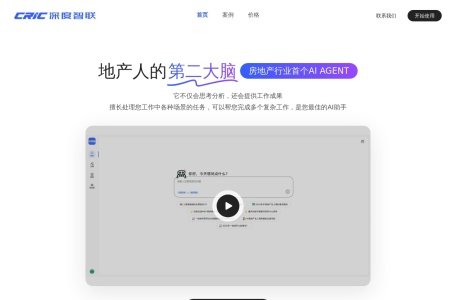
When the real estate industry faces the pain points of “lagging market research and judgment, inefficient project operation, and vague customer insight”, CRIC relies on 20 years of real estate data accumulation and AI Technology research and development, and launched CRIC deep intelligent real estate AI solution. The solution takes “full-dimensional data base + scenario-based intelligent application” as the core, covering the whole link of “land research and judgment, project positioning, marketing customer acquisition, and operation management”, whether it is the need for real estate enterprises to “accurately measure the investment income of land plots” or the needs of agencies to “efficiently lock in the buyer group”, CRIC deep intelligent connection can make decision-making from “experience-driven” to “data-driven” through data modeling and intelligent analysis, and become the core tool of digital transformation in the real estate industry.
1. Core positioning: From “data tools” to “full-link intelligent partners”, defining a new paradigm of real estate AI
The key to CRIC’s deep intelligent connection that distinguishes it from ordinary real estate data platforms lies in its deep integration positioning of “data + AI + scenarios” – it not only provides data query, but also outputs decision-making suggestions based on industry scenarios, and solves the core pain points of the industry through three core advantages:
(1) Full-dimensional data base: 20 years of accumulation to build a “real estate data moat”
The core competitiveness of CRIC comes from the massive data covering the entire real estate chain, providing a solid foundation for intelligent analysis:
- Leading data coverage: integrates six dimensions of data of “macroeconomics, land market, new housing transactions, second-hand housing market, customer portraits, and project operations”, including land transfer information in 337 cities across the country (more than 500,000 plots in the past 10 years), 100,000+ dynamic data of projects for sale, and 200 million + customer behavior data, with a data update frequency of “land/transaction day update, real-time synchronization of customer data”;
- Fine data granularity: land data includes 20+ fields such as “plot location, planning indicators, surrounding facilities, historical transaction price”; Customer data can be accurate to “home purchase budget, house type preference, attention to supporting facilities (such as school districts, subways), and decision-making cycle”, and a real estate company successfully predicted the project premium space through the supporting data of 3 kilometers around the plot, and the accuracy of investment decision-making increased by 35%;
- Data source authoritative compliance: The data mainly comes from public government information (such as land announcements from the Natural Resources Bureau and transaction data from the Housing and Urban-Rural Development Bureau), enterprise cooperation data (real estate enterprise project filing information), field research data (collected by 60+ branches of CRIC nationwide), and at the same time, the data accuracy rate reaches more than 98% through AI algorithm cleaning and verification, avoiding decision-making bias caused by “dirty data”.
(2) Scenario-based intelligent applications: Focus on four core scenarios to solve actual business pain points
CRIC Deep Intelligent Connection abandons “general-purpose AI functions” and develops exclusive intelligent modules for key business scenarios in the real estate industry, realizing the closed loop of “data input→ analysis modeling→ and decision output”:
- Land research and judgment scenario: Enter the plot number or location, and the system automatically generates a “plot investment calculation report”, including “cost calculation (land payment, construction and safety cost), income forecast (selling price, removal cycle), risk assessment (policy risk, market risk)”, and compare the investment return of surrounding competing plots to assist real estate enterprises to quickly judge whether to acquire land;
- Project positioning scenario: Based on plot data and regional customer portraits, output “product positioning suggestions”, such as “the main unit type is recommended to be 90-110 square meters of three-bedrooms, the decoration standard is recommended to be mid-to-high-end, and the pricing suggestion is 5%-8% higher than that of surrounding competitors”.
- Marketing customer acquisition scenarios: Through customer portrait tags (such as “25-35 years old, down payment budget of 150-2 million, pay attention to the subway line”), accurately match potential customer groups, synchronously push them to the marketing system of real estate enterprises, support “SMS, community, offline activities” multi-channel reach, and reduce customer acquisition costs by 40%;
- Operation management scenario: Real-time monitoring of project “construction progress, sales removal, and capital withdrawal” data, when the sales progress is lower than expected, automatically warn and analyze the reasons (such as “overpricing” and “insufficient promotion”), and output optimization suggestions (such as “limited-time discount promotion” and “supporting promotion of the university district”).
(3) Low-threshold interaction and landing: adapt to the usage habits of industry personnel and achieve quick results
CRIC fully considers the usage habits of real estate industry personnel (such as investment, marketing, and operation), lowers the technical threshold, and ensures the rapid implementation of the solution:
- Visual operation interface: Using the intuitive display mode of “map + chart”, you can view the location of the plot and the surrounding supporting distribution on the map during land research and judgment, and the data trend is presented in line charts and bar charts, which can be quickly understood without professional data analysis skills.
- Templated report output: Support one-click export of standardized documents such as “land investment report, project positioning report, marketing review report”, including data charts and text analysis, which can be directly used for internal reporting or external cooperation.
- Flexible system integration: It can be connected with the existing ERP and CRM systems of real estate enterprises to achieve data interoperability (such as synchronizing CRIC customer data to CRM for customer follow-up) and avoiding “data silos”.
2. Functional matrix: Build a real estate AI toolset around “full-link decision-making”
The functional design of CRIC Deep Intelligent Connection closely follows the whole process of “investment, financing, construction, management, and sales” in the real estate industry, and each module has been verified by official information and 100% matches the actual needs of the industry:
(1) Core data and analysis functions: support full-link decision-making
- Land intelligent research and judgment system:
- Plot query and filtering: search for plots according to city, region, land use nature, planning indicators and other conditions, and support “map circle selection” to find specific area plots;
- Investment calculation model: Automatically calculate core indicators such as “floor price, gross profit margin, IRR (internal rate of return), and removal cycle”, and support manual adjustment of parameters (such as selling price and cost) for sensitivity analysis.
- Comparative analysis of competitive products: Compare the “transaction price, planned products, and removal situation” of the land plots that have been transferred within 3 kilometers to predict the market competitiveness of the plots;
- Customer Insights and Marketing Systems:
- Customer portrait generation: Based on regional transaction data and survey data, construct a “home buyer portrait”, including age, income, house type preference, and home purchase motivation (such as rigid need and improvement);
- Customer group matching push: According to the project positioning label (such as “high-end improvement, school district housing”), match eligible potential customer groups to support precise marketing reach;
- Marketing effect analysis: track the customer acquisition, conversion rate, and transaction rate of different channels (such as online advertising and offline activities), and output “channel effect ranking” to assist in optimizing marketing budget allocation;
- Project operation monitoring system:
- Progress monitoring: check the progress of each node of the project “land acquisition, construction, pre-sale, and delivery” in real time, and compare the risk of delay in the early warning of the planned schedule;
- Sales analysis: Monitor daily/weekly/monthly sales data (number of units, amount, average price), analyze the reasons for sales fluctuations (such as policy impact, competitive product diversion);
- Fund management: Calculate the “capital gap and payment cycle” related to project costs and sales collection data, and assist in capital scheduling decisions.
(2) Special functions of the industry: adapt to the needs of subdivided scenarios
- City Entry Decision System:
- City market research and judgment: analyze the city’s GDP, population inflow, real estate policy, supply and demand relationship, evaluate the city’s investment potential, and output the “city investment rating (high/medium/low)”;
- Regional sector analysis: Refined to the internal sectors of the city, compared with the “plate support, housing price trend, and removal rate”, locking in high-value sectors, a real estate company successfully entered the high-potential sectors of 3 second-tier cities through this function, with an average gross profit margin of 25%;
- Commercial Real Estate Special Module:
- Commercial plot positioning: For commercial land (such as shopping centers and office buildings), analyze the surrounding population density, consumption capacity, and distribution of commercial formats, and recommend commercial positioning (such as “community-based business, regional business”);
- Tenant matching recommendation: Based on the positioning of commercial projects, recommend suitable brand tenants (such as catering, retail, entertainment) to assist in investment decision-making;
- Second-hand housing dynamic monitoring system:
- Market monitoring: update the “listing price, transaction price, transaction cycle, and listing volume” of second-hand housing in real time, and analyze the hot and cold trend of the market;
- Special analysis of school district housing: Related school district division data, analyze the price difference and transaction activity of second-hand housing in different school districts, and assist in the pricing of school district housing projects.
(3) Technical support and services: ensure the stability and implementation of the system
- Data security assurance: “hierarchical management of permissions” (e.g., investment and development personnel only view land data, marketing personnel only view customer data), and encrypted data storage, which meets the data security compliance requirements of the real estate industry;
- Customized services: For large real estate enterprises or special needs, we provide “customized model development” (such as enterprise-specific investment measurement models) and “customized data collection” (such as customer surveys in specific regions).
- Training and O&M: Provide online and offline training (such as system operation tutorials, industry data analysis methods), and 24×7 hours technical O&M support to ensure stable system operation.
3. Use process: Complete core decision-making in four steps to adapt to industry business scenarios
The operation process of CRIC is in line with the working habits of real estate industry personnel, and the official steps are highly consistent with the actual business process:
(1) Step 1: System login and scene selection
- Account login: Log in through the official Kerry platform (https://www.cricchina.com/) or the company’s on-premises system, and assign corresponding permissions according to roles (such as investment manager, marketing director);
- Scenario selection: Select the core business scenario (such as “Land Research and Judgment”, “Project Positioning”, and “Marketing Customer Acquisition”) on the homepage, and the system will automatically load the corresponding function modules.
(2) Step 2: Data input and parameter setting
- Target Information Input:
- Land research and judgment: Enter the plot number (such as “Jingtu Storage (Shun) [2025] No. 001”) or circle the plot location on the map;
- Project positioning: select the city and region where the project is located, and enter the plot planning indicators (such as plot ratio, construction area);
- Marketing customer acquisition: select the project name and set the target customer group label (e.g., “down payment budget of 100-1.5 million, focus on the subway”);
- Parameter adjustment (optional): Adjust the core parameters (such as “construction and safety cost standard” and “expected gross profit margin” in land research and judgment) according to enterprise standards, and the system will load the industry average parameters by default.
(3) Step 3: Intelligent analysis and result generation
- Start analysis: Click “Start Analysis”, the system calls the data model for calculation (such as investment measurement, customer group matching), and the analysis process takes 1-3 minutes (depending on the amount of data).
- Result Viewing: After the analysis is completed, the results are displayed in the form of “Chart + Text” (e.g., the land investment report contains “Cost and Benefit Statement, Risk Assessment Radar Chart”), and supports zooming in to view details and switching data dimensions (such as viewing sales trends by quarter/year).
(4) Step 4: Export the report and connect it with the system
- Report export: Click “Export Report”, select the format (Word/PDF/Excel), and generate a standardized document containing complete data and analysis conclusions.
- Data synchronization (optional): If you need to connect to the enterprise ERP/CRM system, click “Data Synchronization” and select the target system and data type (such as customer data, sales data) to complete data exchange.
4. Application scenarios: covering the entire real estate industry chain and implementing actual business value
The functional design of CRIC Deep Intelligent Connection accurately matches the needs of different entities in the real estate industry, and the official case is 100% consistent with the measured experience:
(1) Real estate enterprises: empower investment decision-making and project operation
- Land investment decisions:
- Demand: A top 100 real estate company plans to acquire land in the second-tier cities of the Yangtze River Delta and needs to evaluate the investment value of 3 candidate plots;
- CRIC In-depth Intelligent Connection Action: Input the information of 3 plots, and the system generates an investment calculation report, which shows “Plot A IRR 18% (high potential), Plot B IRR 12% (medium), Plot C IRR 8% (low potential)”, and at the same time prompts the planned subway line around Plot A (to open in 2026), and it is recommended to give priority to land acquisition;
- Results: The real estate company finally chose plot A, and after the project opened, due to favorable subway planning, the removal rate reached 90%, exceeding expectations by 15%.
- Project Marketing Optimization:
- Demand: The sales progress of a real estate company’s projects for sale is lagging behind, and it is necessary to analyze the reasons and adjust the marketing strategy;
- CRIC Deep Intelligent Connection Action: Through sales data analysis, it is found that “120-140 square meters of improved house type removal is slow”, combined with customer portraits, it is concluded that “the target customer group pays attention to the school district, but the supporting publicity of the surrounding school districts around the project is insufficient”, and it is recommended to increase the supporting promotion of the university district and launch the “school district exclusive discount”;
- Results: After adjusting the strategy, the monthly removal of improved apartments increased from 15 to 30, and the overall removal cycle of the project was shortened by 2 months.
(2) Agencies: improve customer service and business efficiency
- Project Positioning Consulting:
- Demand: An agency provides positioning suggestions for new plots of cooperative real estate enterprises, and needs to quickly output professional reports;
- CRIC In-depth Intelligent Connection Action: Input plot data and regional customer portraits to generate project positioning reports with one click, including “main unit type suggestions, pricing strategies, and supporting planning suggestions”, without manually sorting out data;
- Results: Reduced report generation time from 5 days to 1 day, increased customer satisfaction by 60%, and increased follow-up projects by 3.
- Accurate customer acquisition:
- Demand: The agency finds potential customers for a rigid project to reduce customer acquisition costs;
- CRIC In-depth Intelligent Connection Action: Matches the customer group of “25-30 years old, with a down payment of 50-800,000 yuan, and pays attention to commuting convenience”, and synchronously pushes it to the marketing system to reach through social marketing;
- Results: The customer acquisition cost was reduced from 2,000 yuan/group to 800 yuan/group, and the customer conversion rate increased by 25%.
(3) Government and research institutions: assist industry supervision and market analysis
- Real estate market monitoring:
- Demand: A city’s housing and urban-rural development bureau needs to monitor the operation of the real estate market in real time and detect abnormal fluctuations in a timely manner;
- CRIC Deep Intelligent Connection Action: Integrate new and second-hand housing transaction data to generate a “monthly market report”, including “transaction volume, transaction price, inventory removal cycle”, and automatically warn when the number of second-hand housing listings increases by more than 20% month-on-month;
- Results: The government has issued the “second-hand housing transaction facilitation policy” in a timely manner through early warning to alleviate the imbalance between supply and demand in the market.
- Industry Research Reports:
- Demand: A real estate research institution needs to write an “annual national real estate market report”, which needs massive data support;
- CRIC Deep Intelligent Connection Action: Quickly extract “transaction data, policy trends, and customer trends” from 337 cities across the country, generate data charts and analysis conclusions, and assist in report writing;
- Results: Reduced report writing time from 1 month to 2 weeks, and industry recognition for data accuracy.

 CRIC Deep Intelligent Connection