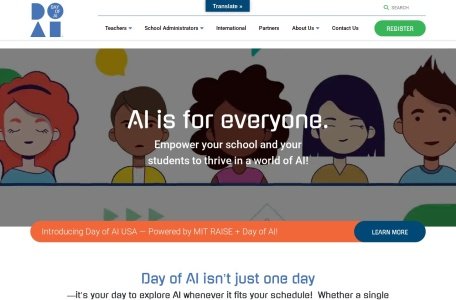
As McKinsey predicts that 50% of jobs will be reshaped by AI by 2030, “AI literacy” has evolved from an optional skill to a must-have for K-12 education. Enter Day of AI—a program launched by MIT’s RAISE team that’s building a bridge to the AI era for global youth through free, open-source resources. By 2025, this educational initiative has reached over 110 countries and engaged 500,000 students, breaking down barriers to quality education and redefining core standards for AI learning among teenagers. Drawing on official materials and real-world case studies, this guide unpacks the program’s curriculum features, practical applications, and educational impact.
I. What is Day of AI? MIT’s Mission for Inclusive AI Education
Day of AI is more than a single course—it’s a K-12 AI literacy ecosystem developed by MIT’s Media Lab in collaboration with institutions like the Schwarzman College of Computing. Its core mission stems from the full name of the RAISE project: “Responsible AI for Social Empowerment and Education.” Unlike commercial skill-building programs, it focuses on three key goals:
- Literacy Enlightenment: Helping 8–18-year-olds understand AI’s fundamental principles and social impacts, rather than just teaching tool usage;
- Responsibility Cultivation: Guiding students to “design and use AI responsibly” through ethics-focused lessons, addressing risks of technological misuse;
- Educational Equity: All curricula and tools are fully free and open-source, ensuring equal access regardless of location or economic background.
An independent 2023 evaluation found that participants—both students and teachers—showed significant improvements in AI knowledge, along with a greater optimism about technology’s social value. This validates Day of AI’s mission to “empower the next generation through education.”
II. Core Curriculum: A 3-Stage Path from Fundamentals to Cross-Disciplinary Practice
Centered on “experiential learning,” Day of AI’s curriculum is structured to build skills progressively. Its depth rivals parts of MIT’s undergraduate AI modules, yet it uses everyday examples to keep learning accessible.
1. Stage 1: AI Fundamentals (Ages 8+)
Focused on answering “What is AI?” this stage breaks down abstract concepts through gamified learning:
- Algorithm Introduction: Using daily scenarios like “baking a cake” or “washing hands,” it explains the three core elements of algorithms: input, processing, and output;
- Data Thinking: Leveraging Google’s “Quick, Draw!” doodle game, students gain a hands-on understanding of how “machines learn from datasets”;
- Ethics Basics: Discussions on “how AI makes judgments” introduce foundational ethical topics like data bias and privacy protection.
Lessons at this stage are just 15–20 minutes long, with downloadable PPTs and teaching guides. Parents don’t need professional backgrounds to support their children’s learning.
2. Stage 2: Real-World AI Applications (Ages 12+)
This stage connects AI to social issues, fostering cross-disciplinary thinking:
- Scenario-Based Cases: Analyzing practical uses like ChatGPT for learning, AI-driven deforestation monitoring, and climate change simulation;
- Civic Awareness: Exploring AI’s impact on election fairness, social media regulation, and financial decision-making to strengthen digital citizenship;
- Hands-On Tools: Introducing MIT’s Picaboo tool, which lets students act as scientists by training their own image classification models.
One notable example: A student used skills from this stage to design an app that tracks deforestation trends in Massachusetts—highlighting the curriculum’s real-world relevance.
3. Stage 3: AI Creation & Coding (Ages 15+)
Bridging coding skills, this stage transforms students from “users” to “creators”:
- Visual Programming: Using Scratch, students participate in the “Dancing with AI” project to train AI robots to perform specific movements;
- App Development: MIT’s App Inventor tool allows students to integrate AI features into self-designed mobile apps—no advanced coding required;
- Advanced Practice: On the RAISE Playground interactive platform, students experiment with debugging and optimizing simple machine learning models.
All courses include full code templates and tutorial videos, enabling independent project completion.
III. Unique Resources & Tools: An Ecosystem Beyond the Curriculum
Day of AI’s competitive edge lies in its complete “curriculum + tools + support system” ecosystem—with a strong focus on empowering educators.
1. Free Open-Source Tools
- RAISE Playground: A no-code interactive platform for exploring AI models and robot programming;
- App Inventor: A visual development tool that lets users build AI-enabled apps without professional coding skills;
- Teaching Resource Kits: Including syllabi, assessment rubrics, and classroom activity plans—ready for teachers to integrate into daily lessons.
2. Teacher Professional Development
Targeted training for educators covers:
- AI Pedagogy: How to integrate AI concepts into traditional subjects like math and history;
- Safety Policy Design: Helping schools create AI usage guidelines to protect student data and ensure fair access;
- Community Exchange: A global network where educators share teaching cases and receive expert feedback from MIT’s team.
3. Family & Community Extension
The official website supports multiple languages (including Chinese). Parents can use the “Family Guide” to support learning, while communities can organize AI workshops using open-source resources to promote inclusive education.
IV. User Guide: 4 Steps to Get Started
Day of AI has minimal barriers to entry—schools, teachers, and families can launch it quickly:
1. Registration & Access
- Individual Users: Sign up with an email (no password required) and switch to the Chinese interface if needed;
- Schools/Institutions: Apply for partnerships via the official website to access customized curricula and technical support.
2. Resource Acquisition
- Curriculum Materials: Filter courses by age in the “Curriculum” section—PDF lesson plans, PPTs, and videos are available for direct download;
- Tool Preparation: Some activities require a Google account (for document access). Users in China can use compliant tools to connect;
- Chinese Localization: Domestic organizations have released optimized Chinese translations. These can be accessed via platforms like “Brainstorm AI Lab.”
3. Recommended Learning Paths
- Younger Children (8–10): Parents guide them through Stage 1, with 1–2 lessons per week focused on gamified experiences;
- Middle Schoolers (11–14): Independently complete Stages 1–2, and participate in “AI + subject” projects (e.g., using AI to analyze historical data);
- High Schoolers (15+): Finish all three stages and develop original projects—these can be used as portfolio materials for college applications.
4. Key Notes
- Copyright: Courses are free for non-commercial use. Institutions may not download and resell them for profit;
- Privacy Protection: Student data is only used for learning assessments, and the platform strictly adheres to children’s privacy regulations;
- Updates: Follow the “Evaluation Reports” section on the official website for the latest curriculum upgrades and case studies.
V. Why Choose Day of AI? 3 Core Advantages
- Authoritative Endorsement: MIT scientists directly design the curriculum, ensuring content aligns with cutting-edge AI education principles and avoids misinformation;
- Zero-Cost Access: From courses to tools, everything is free—breaking the myth that “quality AI education requires high fees”;
- Long-Term Value: It cultivates “ethical awareness + practical skills + cross-disciplinary thinking”—core competencies for the AI era, not just short-term skills.
Conclusion: Empowering Every Child to Shape AI’s Future
In a world where AI evolves rapidly, Day of AI’s value goes beyond knowledge transfer. It uses inclusive education to ensure global youth can participate in technological change as “creators,” not just “observers.” As MIT emphasizes: “The future of AI should be shaped by a generation that understands its principles and responsibilities.”
Whether schools adopt its curriculum, teachers use it to enrich lessons, or parents use it to guide their children’s learning, this free, open-source program offers actionable solutions. For 2025’s learners, instead of sifting through fragmented information, leveraging MIT’s official resources is the smarter choice—because the best AI education has always been about inspiring thinking, not just teaching tools.

 Day of AI