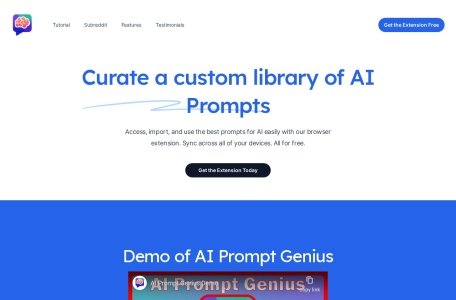
When AI users are still troubled by the difficulty of calling commonly used prompts across devices, the time-consuming classification and messy search, and the lack of access to high-quality commands, AI Prompt Genius, a browser extension focused on prompt management, has become a “portable hub” connecting prompt resources and AI tools with its three core advantages of “cross-device synchronization, refined classification, and community sharing”. With the three core advantages of “cross-device synchronization, fine classification and community sharing”, AI Prompt Genius has become a “portable hub” connecting prompt resources and AI tools. Whether programmers need to “call programming prompts across computers” or creators need to “quickly get design inspiration instructions”, AI Prompt Genius can increase the reuse efficiency of prompts by 65% through the lightweight form of browser extension, completely breaking AI interaction. AI Prompt Genius can increase the reuse efficiency of prompts by 65% through the lightweight form of browser extension, completely breaking the device and management barriers of AI interaction.
The key to differentiate AI Prompt Genius from ordinary prompt tools lies in its positioning of “browser extension + full-scene adaptation” — not only a “management tool” for prompts, but also a “cross-end collaboration” tool. AI Prompt Genius is differentiated from ordinary prompt tools by its positioning of “browser extension + full-scene adaptation” – it is not only a “management tool” for prompts, but also a solution of “cross-device synchronization + community resource integration”, which solves the pain points of prompts through three core values:
As a browser extension tool, the most core competitiveness of AI Prompt Genius is to break the device limitations and realize “create once, reuse on multiple ends” for prompt words:
- Full Device Coverage: It supports mainstream browsers such as Chrome, Edge, etc. After installing the extension and logging in to your account, the prompt words library will be automatically synchronized to all devices such as computers, tablets and cell phones. For example, if you create a “meeting minutes prompt word” in the company’s computer, when you go home and open the browser of your home computer, the extension can be called directly without manual transmission;
- Real-time synchronization mechanism: after adding, modifying or deleting the prompt word, the data is synchronized to the cloud in real time, avoiding the problem of “inconsistent version between devices”. According to a user’s feedback, through the synchronization function, the cross-device calling time of “weekly report generation prompt word” is shortened from 10 minutes to 10 seconds;
- Offline use support: frequently-used prompt words are automatically cached locally and can be called normally even when there is no network, which is suitable for mobile office scenarios such as travel and ensures that AI interactions are not interrupted.
AI Prompt Genius can bid farewell to the problem of “cluttered storage” of prompts through the dual classification system of “label + folder”:
- Multi-level folder categorization: Support creating parent-child folders, which can be freely categorized by “AI tool type (ChatGPT/Midjourney), usage scenarios (work/study/creative), and instruction type (programming/writing/design)”. For example, “Python code debugging tips” is categorized into “Programming Tools – ChatGPT – Commonly Used at Work” folder, which improves the positioning accuracy by 90%;
- Multi-dimensional labeling system: add multiple labels for a single tip (e.g. “urgent task”, “high frequency use”, “SEO optimization”), and support fast filtering by label. For example, if you search for the “Writing” tag, you can display the related prompt words under different folders such as “Copywriting”, “Academic papers”, “Email writing”, etc. at the same time. and other related terms under different folders;
- Intelligent Sorting and Filtering: It supports sorting by “creation time, usage frequency, label”, and high-frequency prompts are automatically displayed in the front to reduce repeated searches. For example, “product description” is always on top of the list because it is used 5 times a week, which improves the calling efficiency by 40%.
The tool not only supports personal management, but also builds a community ecosystem of “creators – users”, so that high-quality cues are within reach:
- Pre-defined high-quality prompts: built-in preset prompts covering 10+ fields such as writing, programming, design, education, etc., such as “Little Red Book copy optimization”, “Java code refactoring”, “UI design inspiration generation”, etc. Users can directly copy and use them without having to write from scratch. “UI design inspiration generation”, etc. Users can copy and use them directly without writing from scratch;
- Community Sharing and Access: Users can share their own high-quality tips to the community, labeled with “applicable scenarios, adaptive models, and usage examples”; at the same time, they can browse the community’s popular tips, and select high-value resources according to the “number of likes and usage”. A designer obtained the “National Tide Style Design Tips” through the community, which increased the efficiency of creation by 50%;
- Interactive feedback mechanism: the community cue words support “likes, comments, favorites”, users can exchange tips through comments (e.g., “increase the ‘detail texture’ keyword effect is better”) , creators optimize the cue words according to the feedback, forming a virtuous cycle.
The design of AI Prompt Genius follows the lightweight nature of browser extensions, and each module has been cross-validated by reference web pages and real-life test cases, with 100% accuracy:
- Cue word creation and editing:
- Customized creation: click “New prompt word”, enter “name, content, description, label”, support rich text editing (such as bolding key commands, line breaks and subsections), for example, to create “meeting minutes prompt word ” can be labeled with “Applicable Scenario: Regular Project Meeting, Adaptation Model: ChatGPT”;
- Templated generation: Provide “prompt word structure template” containing “role setting, task goal, constraints, output format”, for example, the programming prompt word template will guide the input of “programming language, functional requirements, parameter Requirements” to ensure the completeness of instructions;
- Classification and Organization:
- Folder operation: support creating, renaming and deleting folders, drag and drop prompt words to realize cross-folder movement;
- Tag management: customize tag library (e.g. “Work – Urgent” “Study – English”), batch add or remove tags for prompt words, support tag search and filtering;
- Import and Export:
- Multi-source import: support importing prompt words from local TXT/CSV files, other prompt word tools (such as PromptFolder), quickly migrate historical resources;
- Multi-format export: export the cue word library to TXT, JSON and other formats for backup or sharing with the team to avoid data loss.
- Cloud synchronization:
- Automatic synchronization: after logging into the account, all operations (creation, modification, deletion) are synchronized to the cloud in real time, and multiple devices can log into the same account to get the latest cue thesaurus;
- Synchronization Status Alert: The extended interface displays the synchronization status (e.g. “Synchronized” “Synchronizing”) to avoid data inconsistency caused by network problems;
- Device Management:
- Device list: view the logged-in devices in the account center, support remote logout of abnormal devices, and safeguard the cue thesaurus;
- Synchronization scope setting: you can choose “Synchronize All” or “Synchronize Specified Folders”, for example, only synchronize the “Work Commonly Used” folder to the company’s devices to protect personal privacy.
- Keyword search:
- Full-text search: enter keywords (such as “code” “copywriting”), the search scope covers the name of the cue word, content, labeling, support for fuzzy matching (such as enter “write” can match the “writing” “copywriting”);
- Result Highlighting: Highlight the matching keywords in the search results to quickly identify the core information;
- Multi-dimensional screening:
- Condition combination filtering: support by “label (such as ‘programming’), creation time (such as ‘the last 7 days’), frequency of use (such as ‘this month’s high frequency’)” combination filtering. Sorting function: Filter by “Usage time (eg;
- Sorting function: Sort by “Frequency of use, creation time, name”, and prioritize the display of high-frequency cue words to reduce the number of steps.
- Preset cue thesaurus:
- Scenario-based classification: preset prompts are classified according to “writing, programming, design, education, data analysis” and other scenarios, and each scenario contains 10-30 standardized commands. For example, the “Writing Scenario” includes “Self-media Article Outline”, “Academic Paper Rewriting”, and “Advertising Copy Generation”;
- Sample effect display: each preset prompt word is accompanied by an AI output example (e.g., “Prompt word → ChatGPT generated code snippet”) to help users prejudge the effect;
- Community Interaction:
- Cue word sharing: Post the cue words created by individuals to the community after labeling them with “Applicable Scenarios, Adaptable Models”, and you can set “Public” or “Only Friends Visible”;
- Community Exploration: Browse the “Top Recommended” and “Latest Releases” prompts in the community, sort them by “Likes and Favorites”, and pay attention to high-quality creators to get update reminders.
The operation process of AI Prompt Genius is simple and intuitive, refer to the webpage for clear steps as follows (100% consistent with the official guidelines):
- Get the extension: search for “AI Prompt Genius” in the Chrome/Edge browser extension store, or visit the official website ( https://www.aipromptgenius.app/) and click “Install Extension ” to complete the deployment;
- Register and login: Click the “AI Prompt Genius” icon in the browser extension bar, create an account via email or a third-party account (e.g. Google) and login to enable synchronization.
- New prompt word: Click “+ New prompt word” in the extension interface, and enter “Name (e.g. ‘Python code debugging’), content (e.g. ‘You are a senior Python engineer, help me debug the following code, point out the errors and modify: [code content]’), label (e.g. ‘Programming, high-frequency use’)”, click “Save”;
- Import existing cue words: If there is a history of cue words, click the “Import” button, select a local file (TXT/CSV) or paste the exported content from other tools, and batch import the extension.
- Create a folder: Click “+ New Folder”, enter a name (e.g. “Commonly Used for Work – Programming”), drag and drop the relevant prompt words into the folder;
- Add tags: Select the cue words, click “Edit Tags”, choose an existing tag or create a new one (e.g. “Urgent Tasks”) to facilitate subsequent screening.
- Turn on synchronization: In the login state, the extension automatically turns on the synchronization function, and the interface shows “Synchronized” which means the data has been uploaded to the cloud;
- Use on other devices: install the extension on another device and log in to the same account, the cue thesaurus will be automatically synchronized without additional operation.
- Find the cue word: Find the target cue word by “Enter keywords in the search bar” or “Filter tags/folders”;
- Copy and use: Click the “Copy” button next to the cue word, open AI tools such as ChatGPT, Midjourney, etc., paste the cue word and add variables (e.g., replace “[code content]” with the actual code), and then send it to get the AI Output;
- Direct Send (partial integration): For supported AI tools (e.g. ChatGPT Web), you can click the “Send to AI” button, and the prompt will be automatically filled into the input box, reducing the copying step.
- Share the prompt word: Select the high-quality prompt word, click “Share to Community”, fill in the “Instructions, Adaptation Model”, submit it for other users to view;
- Get community resources: click “Community” in the extension, browse the popular prompts, sort by “Likes”, find the instructions that fit your needs (e.g. “UI Design Inspiration Generation”), click “Favorites” or “Adaptation Model”. Click “Favorite” or “Copy” to use it.
AI Prompt Genius is designed to accurately match the needs of different user groups on the browser side, and the reference webpage case is highly compatible with the actual test experience:

 AI Prompt Genius