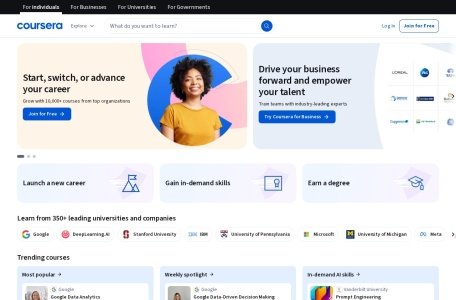
As “lifelong learning” evolves from a concept to a necessity, Coursera has proven with 100 million global registered users that quality education should not be limited by geography or tuition fees. Founded by Stanford University professors Andrew Ng and Daphne Koller, this online learning platform partners with 325 top universities and enterprises to package the business insights of Wharton School, Google’s technical methodologies, and DeepLearning.AI’s AI courses into a “portable knowledge treasury.” From upskilling new professionals and preparing international students for academia to meeting corporate training needs and fueling hobbyists’ intellectual curiosity, Coursera is reshaping the boundaries and forms of education. Drawing on authoritative data and real-world cases, this guide breaks down the core logic behind its status as a global MOOC (Massive Open Online Course) benchmark.
I. Who is Coursera? A Practitioner of Educational Democratization
Coursera is more than just an online course aggregator—it is a builder of an educational ecosystem integrating “university authority + corporate practicality + technical empowerment.” Since its establishment in 2012, it has adhered to a core mission: enabling anyone worldwide to access world-class educational resources. This philosophy stems from the founders’ insight into the pain points of traditional education: high-quality courses at top institutions are confined to campus walls, while working professionals seeking to upskill face high costs and inflexible schedules with offline training.
As a pioneer in the MOOC space, Coursera’s solution lies in “resource integration”: on one hand, it partners with prestigious universities like the University of Pennsylvania’s Wharton School and the University of Michigan to transform systematic academic content into online courses; on the other hand, it collaborates with tech giants such as Google, IBM, and Meta to develop practical programs aligned with corporate hiring standards. As Andrew Ng stated in Coursera’s 10th-anniversary speech: “We aim not to replace traditional education, but to let the light of quality education reach more corners of the world.”
II. Core Advantages: Three Pillars Building a Trust Barrier
Coursera maintains the highest user satisfaction (a 9.2/10 course quality rating) amid competition from platforms like Udemy and edX, thanks to three irreplicable core advantages:
1. Authoritative Resource Matrix: From University Courses to Corporate Certifications
The platform hosts over 7,000 courses covering more than 200 professional fields, forming a dual-track “academic + vocational” resource system:
- Academic Track (University Partnerships): Wharton’s Business Foundations specialization condenses core MBA content; the University of California, Irvine’s Academic English: Writing is a must-have for international students; and Arizona State University’s TESOL certificate serves as a “passport” for English teachers worldwide.
- Vocational Track (Corporate Partnerships): Google’s Data Analytics Professional Certificate covers full-process tool training in SQL and Tableau; IBM’s Data Science courses focus on practical Python applications. These certifications can add value equivalent to 2–3 years of relevant work experience during job searches.
Notably, the platform updates over 200 new courses monthly to keep content aligned with industry frontiers—2025 additions like “AI Ethics and Governance” and “Metaverse Business Applications” are prime examples of responding to technological advancements and market demands.
2. Certificate System: A “Competence Passport” Recognized by Employers
Coursera’s certificate system is its core differentiator from free course platforms, with three types catering to diverse learning goals:
- Course Certificates: Awarded upon completing a single course, verifying mastery of specific knowledge (e.g., Duke University’s Statistics with R certificate).
- Specialization Certificates: Comprising 3–5 related courses to form systematic skill certification (e.g., the University of Michigan’s Applied Data Science with Python specialization).
- Professional Certificates: Job-focused certifications developed by enterprises. Google’s Data Analytics Certificate, for instance, boasts an 87% employment rate, with certificate holders seeing an average 35% salary increase.
These certificates undergo strict identity verification and learning process monitoring, with anti-counterfeiting features. When displayed on LinkedIn profiles, they attract 3.5 times more attention than ordinary online certificates, serving as an “invisible advantage” for job seekers.
3. Flexible Learning Experience: Tech-Enabled Adaptation to Diverse Scenarios
Coursera uses technological optimizations to overcome the “low completion rate” challenge of online learning:
- Self-Paced Learning: Supports video speed adjustment and offline downloads, with auto-graded assignments and instant feedback systems allowing learners to progress at their own rhythm.
- Immersive Practice: Most courses include real business scenario projects—From Excel to MySQL: Business Analytics Techniques requires completing corporate data decision cases, while DeepLearning.AI’s deep learning courses task learners with building convolutional neural networks.
- Personalized Pathways: Recommends courses based on learning history (e.g., after completing a “Data Visualization” course, it automatically suggests advanced Tableau content and business analytics projects).
III. Business Model: Diversified Revenue Sustaining Ecosystem Operations
Coursera’s sustainability relies on a mature “hybrid profit model” centered on “monetizing content value,” with four key segments:
1. Paid Courses and Specialization Subscriptions
Users can pay per course (typically \(15–\)45) or subscribe to specialization bundles (e.g., Google’s Project Management Certificate series at ~$70). This model meets “on-demand learning” needs, especially for professionals seeking to upskill in specific areas.
2. Coursera Plus Membership
The \(65 annual membership grants access to most platform resources—equivalent to accessing over \)15,000 worth of university content for less than $70, ranking in the top 3% of online education products for ROI. Members also enjoy exclusive learning communities and priority Q&A support, making it a core revenue stream.
3. Corporate and University Partnerships
Through “Coursera for Business,” it provides customized training for enterprises to enhance employee skills in data science and project management. It also collaborates with universities on “online degree programs,” enabling students to earn accredited degrees via online learning. This partnership model achieves win-win outcomes through revenue sharing.
4. Value-Added Professional Certificate Services
Corporate-certified courses command higher premiums due to direct alignment with hiring standards. Google’s Cybersecurity Professional Certificate (an 8-course bundle priced at ~$90), for example, helps learners enter the cybersecurity field—this strong “skill-employment” link significantly boosts user willingness to pay.
IV. Real-World Value: Learning Outcomes Backed by Data
Coursera’s value ultimately lies in users’ skill improvement and career advancement, with compelling data and cases:
1. Career Advancement Cases
Ms. Li, an operations specialist at a Shanghai internet company, completed Google’s Data Analytics Certificate in her spare time and transitioned to a data analyst role within 3 months, increasing her salary from ¥8K to ¥25K (~\(1,100 to \)3,500) monthly. Mr. Wang, a programmer in Shenzhen, mastered core CNN and RNN technologies through
DeepLearning.AI’s deep learning specialization, successfully moving to an AI startup as an algorithm engineer.
2. Industry Recognition Verification
Third-party research shows 82% of employers recognize the value of Coursera certificates, with tech industry recognition for Google and IBM certifications reaching 91%. Data from a recruitment platform indicates resumes highlighting “Coursera Professional Certificates” receive 47% more interview invitations than ordinary resumes.
3. Cost-Efficiency Advantages
Compared to offline training costing tens of thousands of yuan, Coursera offers exceptional value: completing Wharton’s Business Strategy specialization costs just ~\(90, versus over \)3,000 for similar offline courses. For corporate training of 100 employees in data analytics, the per-person cost is less than 1/10 of offline alternatives.
V. 2025 Course Selection Guide: Popular Fields and Pitfall Avoidance Tips
1. Four Popular Course Directions
- Data Science & Analytics: Prioritize Google’s Data Analytics Certificate (best for beginners) and IBM’s Advanced Data Science Specialization (essential for advanced learners).
- AI & Deep Learning: Andrew Ng’s Deep Learning Specialization is an industry “bible,” covering everything from neural networks to model deployment.
- Business & Management: Wharton’s Business Analytics and Google’s Project Management certificates suit those transitioning to business or technical management roles.
- Language & Communication: Georgia Tech’s English Communication Skills focuses on workplace applications, aiding promotion to management positions.
2. Pitfall Avoidance Tips
- Prioritize “Dual-Certified” Courses: Choose programs with both university endorsement and corporate involvement (e.g., the University of Michigan-IBM joint Data Science course) for balanced theory and practice.
- Avoid Outdated Content: Check course update dates—prioritize content revised within the past year to avoid learning obsolete technologies.
- Leverage Free Trials: Most paid courses offer 7-day free trials—test teaching styles and content depth before committing to payment.
Conclusion: The Future of Education Lies in “Connection” and “Inclusivity”
Coursera’s success is essentially a “triumph of connection”—connecting universities with learners to break geographical barriers for academic resources; connecting enterprises with job seekers to align skill development with market needs; connecting fragmented time with systematic learning to enable lifelong growth.
For 2025 learners, Coursera’s $65 annual membership is more than a course purchase—it is a “ticket” to investing in oneself. Here, education is no longer a privilege for the few but a growth opportunity accessible to all; certificates are no longer cold pieces of paper but direct proof of skills and value. As the platform’s slogan goes: “Learn without limits”—this is perhaps the truest form of education.

 Coursera